
Rethinking gearbox development: 5 aspects that make all the difference
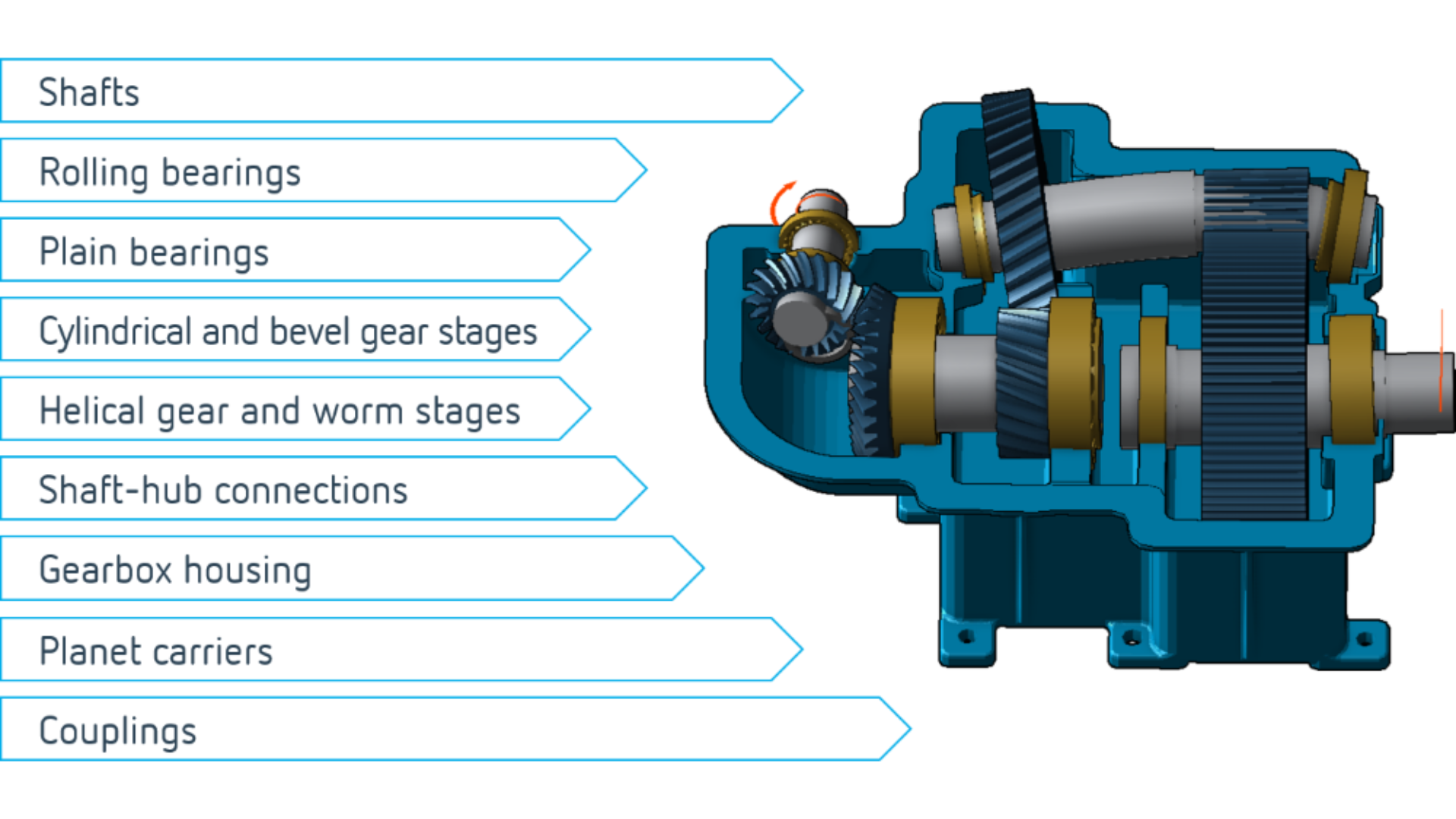
Standard calculations are essential, but for modern gear design, they are often just the beginning. Increasing power densities, shorter development times, and higher demands on efficiency and service life call for a more holistic approach.
A gearbox is more than just the sum of its individual components: deformations affect the load distribution, local stresses occur, and real-world operating conditions involve varying loads. Therefore, the following five aspects are becoming increasingly important.
1. The entire system determines the actual load
Shafts, bearings, gears, and casings are often considered separately in traditional calculations. In a real gearbox, however, they influence one another. Shafts bend, bearings shift, and casings deform. This alters the load distribution and meshing conditions.
Especially in the case of heavily loaded and weight-optimized gearboxes, even slight displacements can have a significant impact on the gearing. An isolated analysis of individual components can only partially account for these interactions.
2. Critical stresses often hide in the details
Standard methods provide standardized and essential information on the load-carrying capacity. However, a global safety factor is not always sufficient for optimization. Where stresses occur on the tooth flank and how they are distributed can have a decisive effect.
A locally resolved analysis reveals the influence of factors such as displacements, load distribution, or flank modifications on the stress. This can also expose relationships a single parameter fails to reveal.
3. The service life depends on the actual operation
Most gearboxes do not operate continuously at rated loads. Acceleration and braking, changing wind conditions, or varying operating conditions create unique load spectra.
The service life is determined not only by the magnitude of a load, but also by the frequency and sequence of load cycles. Individual nominal load points can only partially describe the actual operational behavior.
4. Research opens up new calculation possibilities
New calculation methods and findings from research and development are continually expanding the possibilities of gearbox analysis. However, the effort required to implement, validate, and maintain such methods over the long term is also increasing.
This creates a gap between the available scientific expertise and its application in industrial development processes. Practical availability is a determining factor in how much value they deliver, especially for complex calculation methods.
5. Efficient development processes are a key success factor
As product complexity rises, computational effort is not the only thing that is increasing. Model creation, data transfer, variant comparison, and documentation also take additional time.
If different tools are used for design, system analysis, load-carrying capacity verification, and load spectrum analysis, this can lead to data disconnects and potential inconsistencies that become a significant organizational burden, especially when dealing with many variants.
From standard-based verifications to holistic gearbox development
These five aspects demonstrate that modern gearbox development requires more than just standard-based verifications. Standard calculations continue to establish a baseline, but should be supplemented by additional analyses where system interactions, local stresses, or real-world operating conditions come into play.
Additional analysis does not necessarily mean increased complexity. The key is to integrate the various calculation methods into a consistent development process. The FVA-Workbench establishes a competitive advantage by combining standard calculations with system simulations, locally resolved analyses, and the evaluation of real load spectra. It supports gearbox development that spans a system-level view, local analysis and realistic service life evaluation, direct transfer of research into practice, and a seamless development process. This is based on more than 50 years of FVA research applied to practical gearbox development.
This provides both reliable evidence as well as additional insights for more precise design, streamlined optimization, and faster development decisions.